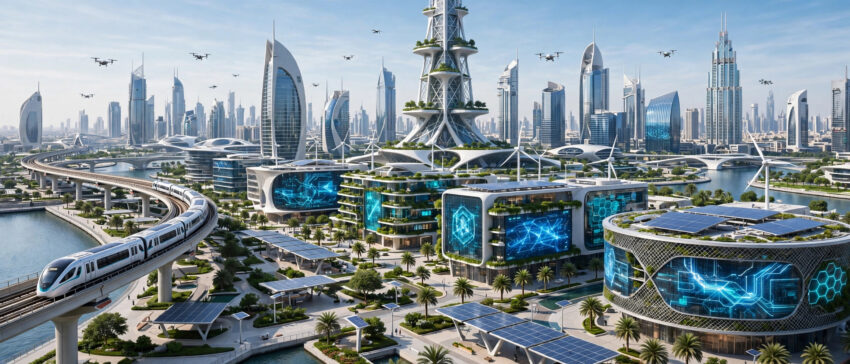
Walk through Dubai on an ordinary morning and the smart city is not a concept on a presentation slide. It is the app you used to pay a utility bill, the metro gate that opened without a paper ticket, the traffic signal that adjusted to the flow of cars, and the government service you completed from your phone instead of a service centre. That is the real story of Dubai smart city projects in 2026: technology that has quietly moved into daily life.
Dubai has spent years building this layer by layer, and the emirate now ranks among the leading smart cities in global indexes. More importantly for residents, the change is practical. Services are faster, journeys are easier to plan, and most official work no longer starts with printing documents and standing in a queue. This article explains the main projects behind that change, how they affect people who live and work in the UAE, and what is likely to come next.
What Does “Smart City” Actually Mean in Dubai?
A smart city uses connected systems and data to run everyday services better. In Dubai, that work is coordinated mainly through Digital Dubai, the government body responsible for the emirate’s digital transformation, working with entities such as the Roads and Transport Authority (RTA), Dubai Electricity and Water Authority (DEWA), Dubai Police and Dubai Health Authority.
The approach has a few clear goals: make government services fully digital, use data to plan transport and utilities, cut paperwork and wasted trips, and build an economy where technology companies want to operate. For residents, those goals show up as simpler apps, shorter processing times and services that increasingly talk to each other instead of asking for the same document again and again.
Paperless Government and the DubaiNow App
The most visible change for most people is paperless government. Dubai’s paperless strategy pushed government entities to stop internal paper transactions and move services online, and the DubaiNow app became the single front door for many of them. Through one app, residents can pay DEWA and telecom bills, handle vehicle and driving services, pay fines, access housing and residency related services, and complete many other routine tasks.
The benefit is not only convenience. When a bill, a fine and a renewal sit in one place, people miss fewer deadlines and make fewer unnecessary trips across the city. Businesses gain as well, because routine approvals and payments take hours instead of days. If you are new to the UAE, installing DubaiNow and UAE Pass, the national digital identity used to sign in to government services, is one of the first practical steps worth taking. Our guide to UAE government apps every resident should know is a useful companion to this article.
Smarter Transport: Metro, Roads and Autonomous Travel
Transport is where smart city investment is easiest to feel. The Dubai Metro and tram network already run as highly automated systems, Nol cards and digital payments have replaced paper tickets, and parking, Salik tolls and vehicle services are managed electronically.
On the roads, the RTA uses intelligent traffic systems that monitor congestion and adjust signals in real time, while apps give drivers live information before they set out. Dubai has also set a long-term target for a meaningful share of journeys to be made using autonomous transport by 2030, and self-driving vehicle trials have been running in selected areas. Electric vehicles are part of the same picture, with public charging expanding across the emirate. If that shift interests you, read our earlier coverage of the future of electric vehicles in the UAE.
For daily life, the result is simple: journeys are more predictable. A commuter in Jebel Ali or Al Qusais can check conditions, pay for parking and renew a registration without visiting three different offices.
Smart Utilities and Clean Energy
DEWA’s smart grid programmes and smart meters give households a clearer view of their electricity and water use, and allow many services, from move-in connections to bill payments, to be handled online. Small changes matter here. A tenant who can track consumption tends to spot a leaking tap or an air conditioner fault earlier, which saves money and water in a desert city where both count.
Behind the scenes, the Mohammed bin Rashid Al Maktoum Solar Park is one of the largest single-site solar projects in the world and a central part of Dubai’s clean energy strategy. As its capacity grows, a larger share of the power behind those smart services comes from renewable energy generated inside the emirate itself.
Artificial Intelligence in Public Services
Artificial intelligence has moved from pilot projects into ordinary service delivery. Government call centres and chat assistants handle routine questions at any hour, document processing is increasingly automated, and entities across Dubai have been appointing officers responsible for AI adoption in their departments. The UAE has also supported this direction nationally, from its dedicated minister for artificial intelligence to programmes that train government staff and students in AI skills.
Used well, this does not remove people from public services. It removes waiting. A resident asking about a renewal at midnight gets an immediate answer, and staff time is freed for complicated cases that genuinely need a human decision. Readers exploring this area may also enjoy our overview of AI tools that are useful in everyday work.
Smart Safety and Healthcare
Dubai Police is often cited internationally for its smart police stations, which allow residents to report issues, pay fines and access services around the clock without a traditional counter visit. Smart surveillance and rapid response systems support safety across busy public areas, while keeping routine police paperwork largely digital.
In healthcare, digital records, online appointments and telemedicine options have become normal, particularly since the pandemic years accelerated their adoption. Early detection and data-driven screening programmes are a growing focus for health authorities, aiming to catch common conditions sooner, when treatment is simpler and cheaper.
What This Means for Businesses and Startups
A smart city is also a business environment. Fast digital licensing, online banking, strong data infrastructure and free zones focused on technology, such as Dubai Internet City and Dubai Silicon Oasis, make the emirate attractive to founders. It is no coincidence that so many regional technology headquarters sit here. Our list of leading IT companies in Dubai shows the depth of that ecosystem, from telecom operators to global cloud providers.
For small businesses, the practical gains are more modest but just as real: trade licences renewed online, customs and logistics tracked digitally, and customers who expect to pay, book and communicate through their phones as a matter of course.
Challenges a Smart City Still Has to Solve
None of this is finished, and honesty matters. A connected city collects a great deal of data, so privacy and cybersecurity have to keep pace with convenience. The UAE has introduced a federal personal data protection law, and residents should still take basic precautions: use UAE Pass and official apps, check web addresses before entering payment details, and be careful with messages that imitate government services.
There is also a human side. Digital services work best for people who are comfortable with smartphones and online payments. Elderly residents and new arrivals sometimes need help, and good service design, plus support in service centres, remains important so that nobody is locked out of essential services.
Frequently Asked Questions
Who is responsible for Dubai’s smart city programme?
Digital Dubai leads the emirate’s digital transformation, working with government entities such as the RTA, DEWA, Dubai Police and Dubai Health Authority, each of which runs smart projects in its own sector.
Which app should a new Dubai resident install first?
Start with UAE Pass for digital identity and DubaiNow for everyday government services and payments. Add the RTA related apps if you drive or use public transport regularly.
Is Dubai really planning driverless transport?
Yes. Dubai has a long-term strategy to convert a significant share of trips to autonomous modes by 2030, and trials of self-driving vehicles have already taken place in selected districts.
Are Dubai’s smart services available in English?
Yes. Major government apps and portals such as DubaiNow and UAE Pass are available in Arabic and English, which makes them accessible to the UAE’s large expatriate population.
Conclusion
Dubai smart city projects in 2026 are not about a single mega-project. They are about hundreds of services becoming digital, connected and easier to use, from paying a bill to renewing a licence to planning a journey. For residents, the advice is simple: set up UAE Pass, use the official apps, and let the systems do the paperwork. The city is still building, and if the last few years are any guide, daily life in the UAE will keep getting a little smarter each year.