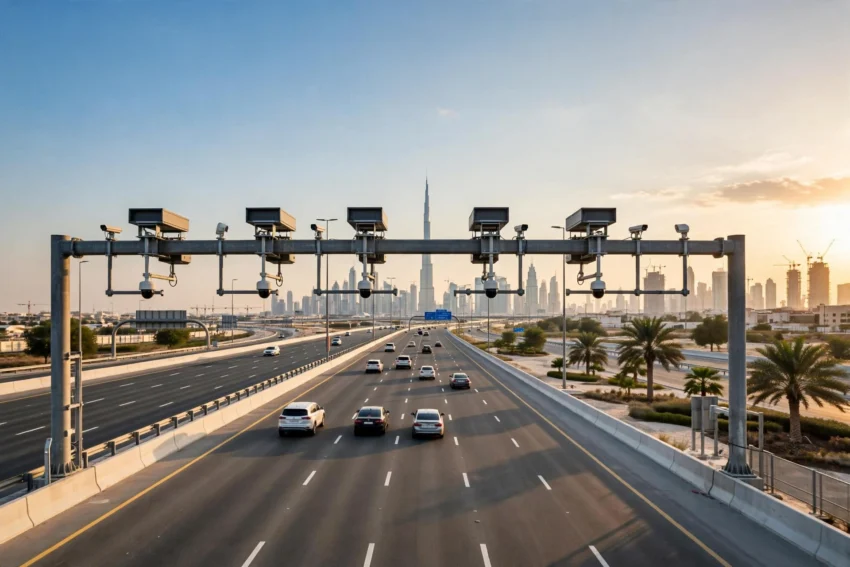
Driving in the UAE is a pleasure most days. The roads are wide, well maintained and clearly signposted, and the motorways between Dubai, Abu Dhabi and Sharjah are among the best in the region. But the same system that keeps traffic flowing also watches it closely. Fixed cameras, mobile radars and smart monitoring record violations automatically, and a fine can land on your traffic file before you even realise you made a mistake.
If you drive in the Emirates, sooner or later you will need to check a fine, pay one, or work out what the black points on your licence actually mean. This guide explains the UAE traffic fines system in 2026 in plain language: what the common fines cost, how the black points system works, where to check and pay online, which discounts are genuinely available, and how to dispute a fine you believe is wrong.
How the UAE Traffic Fines System Works
Traffic penalties in the UAE are set at federal level. The current framework is Federal Decree-Law No. 14 of 2024 on Traffic Regulation, which came into force on 29 March 2025, and the fines themselves follow the published federal violations schedule. That means the headline amounts for speeding, jumping a red light or using a phone while driving are broadly the same whether the violation happens in Dubai, Abu Dhabi, Sharjah or Ras Al Khaimah.
What does differ by emirate is how you check and pay, and whether an early-payment discount is available. Each emirate’s police force manages its own traffic file, so a fine issued in Dubai is checked through Dubai Police or the RTA, while one issued in Abu Dhabi is handled through TAMM or Abu Dhabi Police. The Ministry of Interior (MOI UAE) app brings fines from all emirates together in one place, which is handy if you regularly drive between cities.
A fine is normally made up of three parts: the money amount, black points added to your driving licence, and, for serious offences, a period during which your vehicle is impounded. All three matter. The money is the obvious cost, but the black points are the ones that can take away your licence, and impoundment means paying release fees and being without your car.
Common UAE Traffic Fines and Black Points in 2026
Speeding is by far the most common violation in the UAE, and the penalties rise steeply with every band over the limit. The federal schedule lists the following bands for speeding:
- Up to 20 km/h over the limit: AED 300, no black points
- 21 to 30 km/h over the limit: AED 600, no black points
- 31 to 40 km/h over the limit: AED 700, no black points
- 41 to 50 km/h over the limit: AED 1,000, no black points
- 51 to 60 km/h over the limit: AED 1,500, 6 black points, 15 days’ vehicle impoundment
- More than 60 km/h over the limit: AED 2,000, 12 black points, 30 days’ impoundment
- More than 80 km/h over the limit: AED 3,000, 23 black points, 60 days’ impoundment
Two things catch new drivers out. First, on many roads outside Abu Dhabi, cameras generally only trigger once you are more than 20 km/h above the posted limit, because of the widely used 20 km/h grace buffer. That buffer is a matter of enforcement practice, not a right, and it does not apply everywhere, so it is never safe to rely on it. Second, once you pass 50 km/h over the limit, the penalty stops being just money: black points and impoundment arrive with it.
Other common fines under the federal schedule include jumping a red light at AED 1,000 with 12 black points and 30 days’ impoundment for a light vehicle, using a mobile phone while driving at AED 800 with 4 black points, not wearing a seatbelt at AED 400 with 4 black points, and reckless or dangerous driving at AED 2,000 with 23 black points and 60 days’ impoundment. The exact amounts can change, so always confirm the figure shown on your own fine record before paying.
Understanding Black Points: 24 Points and Your Licence Is at Risk
Black points are recorded against your driving licence, not your car, and they stay on your record for 12 months. If you accumulate 24 black points within a year, your licence can be suspended for at least three months. Two red-light offences in one year, at 12 points each, are enough on their own to reach that threshold.
That is why it is worth checking your points, not just your fines, every few months. A single speeding ticket at AED 300 may feel trivial, but points add up quietly, and several small violations can combine into a suspension. If you share a car with family members, remember that the points go to whoever was driving, so it is important to transfer a fine to the correct driver rather than simply paying it under the vehicle owner’s name.
How to Check Your UAE Traffic Fines Online
Checking a fine takes only a couple of minutes, and you can do it entirely from your phone. You will usually need your plate number, traffic file number, driving licence number or Emirates ID, depending on the platform.
For Dubai fines, use the Dubai Police app or website and choose “Fines Inquiry and Payment”, or the RTA Dubai app or website for vehicle, parking and Salik-related fines. For Abu Dhabi fines, use the TAMM platform or the Abu Dhabi Police app, signing in with UAE Pass. For Sharjah, the Sharjah Police app covers fines issued in that emirate. For a single view of fines from every emirate, use the MOI UAE app or the Emirates Vehicle Gate portal.
If you are new to the country, setting up UAE Pass first makes all of this much easier, because most government platforms now use it as the sign-in method. Our guide to UAE Pass in 2026: How to Set It Up and Use It for Government Services walks through the setup step by step. You will also need your Emirates ID details handy, and our UAE Emirates ID 2026 guide explains how to apply, renew and check its status.
When you check, look at more than the amount. Note the date and location of the violation, the number of black points, whether the vehicle will be impounded, and whether an early-payment discount has already been applied to the figure shown. Taking a screenshot of the fine record is a good habit, especially if you plan to dispute it later.
How to Pay a Traffic Fine in the UAE
Payment runs through the same official channels as the check. In Dubai, pay through the Dubai Police app or website, or through the RTA app or website for RTA fines. In Abu Dhabi, pay through TAMM or the Abu Dhabi Police app. Everywhere else, the MOI UAE app accepts card payments for fines from all emirates.
Payment is by card in almost all online channels, and you receive a digital receipt immediately. Keep that receipt until the fine disappears from your record, which can take a day or two to update. Fines must be settled before you can renew your vehicle registration, and since July 2025 Dubai has also linked unpaid traffic fines to residence visa renewal, transfer and cancellation, so leaving fines unpaid can cause problems well beyond the road.
If a fine is large, ask about instalments before paying it in full. Dubai Police offers an instalment plan service for traffic fines, and the RTA lets you split fines into up to four payments through Tabby on its channels, or into interest-free instalments through partner banks. Abu Dhabi Police also offers zero-interest instalment plans through partner banks for up to 12 months.
Traffic Fine Discounts in 2026: What Is Actually Available
Discounts are where the most confusion exists, because the rules are different in each emirate and change from time to time.
Abu Dhabi offers the clearest standing discount. Under the Abu Dhabi Police “Take the Initiative and Benefit” scheme, fines paid within 60 days of the violation receive a 35 percent discount, and fines paid after 60 days but within one year receive a 25 percent discount. Serious violations, such as running a red light, heavy speeding or driving under the influence, are excluded from the discount at any point.
Sharjah has run similar early-payment schemes, with 35 percent within 60 days and 25 percent within a year, and has also run temporary 50 percent campaigns on occasion. Dubai, by contrast, has no standing early-payment discount. Instead, Dubai Police and the RTA periodically run time-limited discount campaigns around occasions such as Ramadan, Eid and UAE National Day. As of November 2026, no National Day discount campaign had been announced.
The practical advice is simple. Pay Abu Dhabi fines within 60 days whenever you can, because a 35 percent saving is substantial. For Dubai fines, check the Dubai Police or RTA app when a fine appears, because any active campaign discount will be shown on the amount before you confirm payment. Never trust a discount claim from an unofficial website or social media post; the only figure that matters is the one shown on the official payment page.
How to Dispute a Traffic Fine You Believe Is Wrong
Cameras and radars are reliable, but mistakes happen: a plate number can be misread, or a fine can be registered against the wrong vehicle. If you believe a fine is incorrect, do not simply pay it and hope. Paying a fine is generally treated as accepting it.
Instead, gather your evidence first. The violation photo, which is available through the police app in most emirates, is the key document: check the plate number, the vehicle, the date, time and location. Then file an objection through the same platform where the fine appears. Dubai Police, Abu Dhabi Police and the MOI all offer an online objection or grievance service. Explain clearly what is wrong and attach any supporting evidence, such as a photo of your own car, a parking receipt showing you were elsewhere, or proof that the vehicle had been sold.
Objections are reviewed by the traffic department, and the fine is normally frozen while the review is underway. If the objection is rejected, you can usually escalate it, and in some cases the matter can be taken to the traffic court. Keep copies of everything you submit, and note the reference number of your objection.
Simple Habits That Keep Fines Away
Most fines are avoidable with a few steady habits. Set your cruise control on motorways so a downhill stretch does not quietly push you over the limit. Leave your phone in the glove box or on Do Not Disturb while driving, since an AED 800 fine and 4 black points is an expensive notification. Treat amber lights as a signal to stop, not to speed up, because a red-light fine costs AED 1,000, 12 points and a month without your car. And check your fines once a month, even when you expect none: an early check is what lets you use Abu Dhabi’s 35 percent discount, and it stops a forgotten fine from blocking a registration renewal or a visa process.
If you are still learning the rules of the road here, our guide on how to get a UAE driving licence in 2026 covers the process, costs and requirements for residents, including converting a licence from your home country.
Frequently Asked Questions
How do I check my traffic fines in the UAE?
Use the MOI UAE app for fines from all emirates, or your emirate’s own platform: Dubai Police or RTA for Dubai, TAMM or Abu Dhabi Police for Abu Dhabi, and Sharjah Police for Sharjah. You will need your plate number, traffic file number or Emirates ID.
What is the fine for speeding in the UAE in 2026?
Speeding fines start at AED 300 for up to 20 km/h over the limit and rise to AED 3,000, with 23 black points and 60 days’ impoundment, for more than 80 km/h over the limit. Black points begin once you exceed the limit by more than 50 km/h.
How many black points can I get before losing my licence?
Accumulating 24 black points within 12 months can lead to your driving licence being suspended for at least three months. Points stay on your record for 12 months.
Is there a discount on UAE traffic fines?
Abu Dhabi gives a 35 percent discount if you pay within 60 days of the violation and 25 percent if you pay after 60 days but within one year, excluding serious violations. Dubai has no standing early-payment discount but runs occasional campaigns and offers instalment plans. Always confirm the discount on the official payment page.
Can I pay a UAE traffic fine in instalments?
Yes. Dubai Police offers an instalment plan service, the RTA supports splitting fines through Tabby or zero-interest bank plans, and Abu Dhabi Police offers zero-interest instalments through partner banks for up to 12 months.
What happens if I do not pay a traffic fine?
Unpaid fines block vehicle registration renewal, and in Dubai they can also block residence visa renewal, transfer or cancellation. Fines can also increase once discount windows pass, and impounded vehicles attract release fees.
Conclusion
UAE traffic fines are straightforward once you understand the three parts of every penalty: the money, the black points and the possible impoundment. The amounts are fixed by the federal schedule, the discounts depend on the emirate, and everything can be checked and paid online in a few minutes through the MOI UAE app or your emirate’s police platform.
The cheapest fine is always the one you never receive. Drive within the limit, keep your phone away, stop at amber, and check your traffic file once a month. And when a fine does arrive, deal with it quickly: in Abu Dhabi that can save you 35 percent, and everywhere else it keeps a small problem from growing into a blocked registration or a suspended licence.
Disclaimer: This article is general information only and is not legal advice. Traffic fine amounts, discount schemes and procedures can change, and they may vary by emirate. Always confirm the current figures and rules on the official Dubai Police, RTA, Abu Dhabi Police, TAMM or Ministry of Interior channels before paying or disputing a fine.