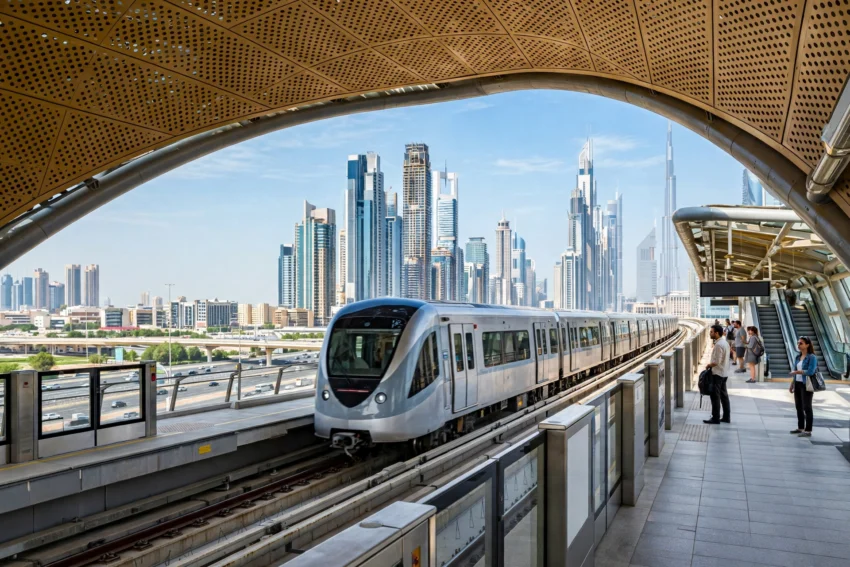
If you live in the UAE or you are visiting for the first time, you do not need a car to get around. The country’s public transport network has grown into something genuinely practical: a driverless metro that runs the length of Dubai, buses that reach almost every neighbourhood, a tram along the Marina, and intercity coaches linking all seven emirates. This guide to UAE public transport 2026 explains how it all fits together, what it costs, and which card you need in your pocket.
Dubai Metro: the backbone of the network
The Dubai Metro is where most journeys start. It is fully driverless, air-conditioned, and runs on two lines. The Red Line runs from Centrepoint in Rashidiya, past Dubai International Airport, Downtown Dubai and Business Bay, all the way along Sheikh Zayed Road to the Marina, Jebel Ali and the Route 2020 branch to Expo City Dubai. The Green Line runs through old Dubai, from Etisalat by e& in Al Qusais through Deira, the Gold Souq, Bur Dubai and Healthcare City to Creek. Together the two lines serve more than 50 stations, and you can change between them at Union and BurJuman stations.
Trains are frequent. During the morning and evening rush you will rarely wait more than a few minutes, and even off-peak the gap is usually under ten minutes. Every train has a women and children cabin, and the front carriage on the Red and Green Lines is the Gold Class cabin, which costs double the standard fare and is noticeably quieter.
Dubai Metro hours in 2026
Metro opening hours are the same on both lines. From Monday to Thursday and on Saturday, stations open at 5:00 in the morning and close at midnight. On Friday, trains run later, until 1:00 in the morning. Sunday is the one day that starts late: the first trains leave at 8:00 in the morning and the service still runs until midnight. Hours are sometimes extended for public holidays, Ramadan, New Year’s Eve and major events, so it is worth checking the RTA website or the RTA Dubai app before an important trip. If you have an early Sunday flight, plan a taxi or a bus instead, because the metro will not be running yet.
The Nol card: one card for metro, bus and tram
Almost all public transport in Dubai runs on the Nol card, a rechargeable smart card issued by the Roads and Transport Authority (RTA). You tap in at the start of your journey and tap out at the end, and the system works out the fare for you. There are four types of card, and choosing the right one saves money.
The Silver Nol card is the default choice for most residents and regular visitors. It costs AED 25, which includes AED 19 of credit, and it is valid for five years. The Gold Nol card costs the same AED 25, but it gives you access to the Gold Class cabins on the metro and tram, and every trip costs double the Silver fare. The Blue Nol card, also called the Personal card, costs AED 70 with AED 20 of credit. It is registered in your name, linked to your Emirates ID, and it is the card that carries the 50 percent discount for students, senior citizens and People of Determination. Finally, the Red Ticket is a paper ticket that costs AED 2 and is aimed at short-stay tourists. It holds up to ten trips, but the fare per trip is higher than on a Silver card, so it only makes sense for a very short visit.
You can buy a Nol card at any metro station ticket office or vending machine, at RTA customer service centres, and through the RTA app. Top-ups work the same way, and you can also top up online. One important rule: every traveller needs their own card. You cannot tap one card twice for two people, because the gates track each journey separately. Keep at least AED 7.50 on a Silver or Blue card before you tap in, or AED 15 on a Gold card, because that is the minimum balance the system needs to let you through the gates.
How much does UAE public transport cost in 2026?
Dubai’s transport network is divided into seven fare zones, and your fare depends on how many zones your journey crosses, not on the distance in kilometres. There are only three price bands, which keeps things simple.
With a Silver or Blue Nol card, a trip within one zone costs AED 3, a trip across two adjacent zones costs AED 5, and any trip crossing more than two zones costs AED 7.50, which is the maximum single fare. Gold Class doubles those fares to AED 6, AED 10 and AED 15. A Red Ticket costs AED 4, AED 6 and AED 8.50 for the same three bands. Blue card holders who qualify for the concession pay half the standard fare: AED 1.50, AED 2.50 and AED 3.75.
There is also a daily cap. Once you have spent AED 14 in a day on a Silver or Blue card, the rest of your rides that day are free until midnight. The Gold Class daily cap is AED 20. If you travel a lot, the passes are worth a look: a one-day pass costs around AED 22 for standard class, a seven-day all-zones pass is around AED 110, and a 30-day all-zones pass is around AED 350 for Silver and AED 700 for Gold. A monthly pass pays for itself if you make two or more metro or bus trips on most working days.
RTA buses: where the metro does not reach
The metro covers the main corridors, but the bus network is what fills in the gaps. RTA buses run across Dubai on the same Nol card and the same zone fares, and many routes are timed to feed the metro stations. Buses are also the way to reach places the metro will never serve, from residential communities like Dubai Silicon Oasis and International City to the industrial areas of Jebel Ali.
Intercity buses are just as useful. Coaches run from Dubai to Abu Dhabi, Sharjah, Ajman, Ras Al Khaimah, Fujairah and Umm Al Quwain, usually from the main bus stations at Al Ghubaiba, Union Square and Ibn Battuta. The Dubai to Abu Dhabi service is one of the busiest intercity routes in the country, and it is far cheaper than a taxi for the same trip. Fares for intercity routes are charged separately from the Dubai zone fares, so check the price at the station or in the app before you board.
Dubai Tram and getting around the Marina
The Dubai Tram runs along Al Sufouh Road through Dubai Marina and Jumeirah Beach Residence, linking the Dubai Marina and Jumeirah Lakes Towers metro stations with the Palm Jumeirah monorail. It uses the same Nol card and the same zone fares as the metro, and it is the easiest way to move around the Marina without a car. Tram hours are roughly 6:00 in the morning to 1:00 the next morning, starting later, at 9:00, on Sundays. Like the metro, the tram has a Gold Class section at the front.
Public transport in Abu Dhabi and the other emirates
Dubai is not the only emirate with a serious bus network. Abu Dhabi runs a large fleet of city and intercity buses, but note that they do not use the Nol card. Abu Dhabi buses run on the Hafilat smart card instead, with a flat fare of about AED 2 per trip inside the city. Sharjah, Ajman and Ras Al Khaimah have their own local bus services too, and the intercity coaches from Dubai connect with them. If you are travelling between emirates, carry both cards or check whether your route accepts cash or card payment on board, because the systems are still separate.
Taxis and ride-hailing fill the last gaps everywhere in the UAE. RTA taxis in Dubai, the Careem app and Uber all work well for the last few kilometres from a metro station to your door, and in Abu Dhabi the local taxi companies run a similar service. For airport trips late at night or early on a Sunday morning, when the metro is closed, a taxi or a booked car is the reliable option.
Apps that make UAE public transport easy
A little preparation makes every journey smoother. The RTA Dubai app and the S’hail app both plan journeys across metro, tram and bus, show live timings and help you top up your Nol card. The Nol Pay app keeps your balance and travel history in one place. If you are new to the country, set these up before your first trip, and if you are a resident, link your Blue Nol card to your Emirates ID so the concession and the balance protection apply. Residents who drive as well may find our guides on UAE traffic fines and on how to get a UAE driving licence useful, and UAE Pass is the app that ties most government services together.
Money-saving tips for daily commuters
A few habits can cut your monthly transport bill noticeably. First, trust the daily cap: once you hit AED 14 on a Silver card, ride as much as you like for the rest of the day. Second, if you commute five days a week, compare your spending with the AED 350 monthly pass before you dismiss it. Third, avoid the Red Ticket unless you are only in Dubai for a day or two, because the higher per-trip fares add up fast. Fourth, if you qualify for a Blue card concession as a student, a senior citizen or a Person of Determination, apply for it: half-price fares for years are worth the one-off AED 70. And finally, always tap out. If you forget, the system charges the maximum fare for that trip, which is an easy mistake to make when you are in a hurry.
Frequently asked questions
Can tourists use the Dubai Metro without a Nol card?
Yes. Tourists can buy a Red Ticket paper ticket at any metro station for AED 2 and load trips onto it. For a stay longer than a couple of days, a Silver Nol card is usually cheaper and more convenient.
What is the minimum Nol card balance needed to travel?
You need at least AED 7.50 on a Silver or Blue card, or AED 15 on a Gold card, to pass through the entry gates. The system holds that amount as a deposit against the maximum possible fare and refunds the difference when you tap out.
Does the Nol card work in Abu Dhabi?
No. Abu Dhabi buses use the separate Hafilat card. The Nol card works across Dubai’s metro, tram and RTA buses, and on intercity buses leaving Dubai, but you will need a Hafilat card for Abu Dhabi city buses.
What time does the Dubai Metro close on Friday?
On Friday the metro runs from 5:00 in the morning until 1:00 the following morning, an hour later than on other days. On Sunday it opens late, at 8:00 in the morning.
Is there a monthly pass for Dubai public transport?
Yes. An all-zones 30-day pass costs around AED 350 for standard class and around AED 700 for Gold Class. It covers unlimited travel on the metro, tram and RTA buses within Dubai.
Final thoughts
Public transport in the UAE has reached the point where it is a real alternative to owning a car, at least in Dubai and Abu Dhabi. The metro is clean, fast and frequent, the Nol card system is simple once you understand the three fare bands, and the daily cap and monthly passes keep regular commuting affordable. The gaps are real too: the metro closes early on Sunday mornings, the emirates still run separate card systems, and the bus is slower than the train for long cross-city trips. But for most daily journeys, and for almost every trip a visitor will make, the network does the job well. Pick up a Silver Nol card, load it with credit, and let the metro do the driving.
Disclaimer: Fares, passes and operating hours are based on RTA published information available at the time of writing and can change. Always confirm the latest fares and timings on rta.ae or in the RTA Dubai app before you travel.